India's Flag is on the Moon
India planted its flag firmly in the lunar soil on November 14, 2008, when its Chandrayan-1 orbiter fired its Moon Impact Probe onto Earth's natural satellite.
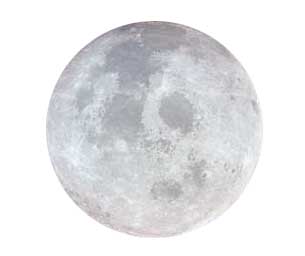
The Moon
The 75-lb. box-shaped MIP carried three instruments in its 25-minute flight down onto the Moon:MIP was painted with India's green, white and saffron flag. The lunar impact fired off celebrations in the Asian nation that hopes to raise its level of global influence. India is the second most populous country on Earth.
- a video imaging system to take pictures of the Moon's surface as MIP approached
- a radar altimeter to measure the rate of descent of the probe to the lunar surface
- a mass spectrometer to examine the extremely thin lunar atmosphere on the way down to the surface
India's first attempt to send a probe to the Moon's surface from its spacecraft orbiting the Moon was successful. Another lunar flight, probably with a soft landing and maybe even a small rover, will be launched in 2012, India announced.
Moon missions. India joined the U.S., Russia in the form of the former Soviet Union, the European Space Agency, Japan and China as the nations that have sent missions to the Moon.
Today, the MIP probably is scattered across the Moon's Shackleton crater where the small probe smashed into the surface at more than 3,100 mph.
Launch. India launched its first unmanned spacecraft to explore the Moon on October 22, 2008.
The Indian Space Research Organisation (ISRO) calls the Moon flight project Chandrayan Pratham, which has been translated as First Journey to the Moon or Moonshot One in ancient Sanskrit.
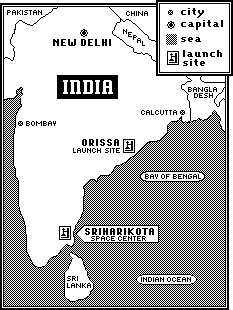
The 1,157-lb. Chandrayan-1 was launched on a two-tyear mission on one of India's own Polar Satellite Launch Vehicle (PSLV) space rockets from the Sriharikota Space Center in southern India.
The spacecraft circled Earth in a geosynchronous transfer orbit (GTO) from where it flew on out into a polar orbit of the Moon some 60 miles above the lunar surface.
The Chandrayan mission will send back to Earth high-resolution 3-D images of the moon's surface including the shadowy polar regions. It is searching for evidence of water or ice. It also will try to identify the chemical breakdown of some lunar rocks.
Chandrayan-1 carries X-ray and gamma-ray spectrometers sending data to scientists on Earth for use in a high-resolution digital map of the lunar surface.
Its remote-sensing instruments are sensitive to visible light, near-infrared light, and low-energy and high-energy X-rays.
Chandrayaan-1 has payloads from the United States and European countries Germany, Britain, Sweden and Bulgaria. India plans to share its Moon data with NASA and other space agencies.
Shar Space Launch Center on Sriharikota Island off India's east coast state of Andhra Pradesh is used by ISRO to launch spacecraft on PSLV and other rockets.
The European Space Agency (ESA) provided three science instruments for Chandrayan-1. They are identical to those already in orbit around the Moon on ESA's Smart 1 spacecraft, which is surveying chemical elements on the lunar surface.
The Indian lunar satellite also houses a U.S. radar instrument designed to locate water ice.
Previously, India has launched weather and communication satellites to Earth orbit.
Why send a probe to the Moon? While the South Asian nation has the second largest population on Earth, it is not a rich country with millions of uneducated and even homeless residents.
Like all other nations sending machines and people to space, India considers funding of its space program to be a matter of prestige. In making the announcement in 2003, Prime Minister Atal Behari Vajpayee said a Moon flight would showcase India's scientific capabilities.
A former science minster in the Indian government, physicist M.G.K. Menon told news media then that Chandrayan-1 would "excite the younger generation." Menon also said the Moon flight would have the effect of "enormously increasing the confidence of the nation."
ISRO said Chandrayan-1 is the first mission in "India's foray into a planetary exploration era in the coming decades." Chandrayan-1 will be the "forerunner of more ambitious planetary missions in the years to come, including landing robots on the Moon and visits by Indian spacecraft to other planets in the Solar System."
Other nations have probed the Moon. The former Soviet Union and the United States conducted the earliest lunar exploration in the late 1950s and the 1960s. Soviet spacecraft were the first to fly by, then land on, and finally orbit the moon. The U.S. Apollo flights were the first manned missions to reach the moon, culminating with six missions that set down on the surface.
Much more recently, India's Asian neighbors, China and Japan, sent spacecraft to orbit the Moon in 2007.
Learn more:
Indian Space Research Organisation CHANDRAYAAN-1: India's first mission to Moon website India's Moon images Indian Government Portal Research Sponsored by ISRO (RESPOND)
Vikram Sarabhai Space Centre (VSSC) Space Applications Centre (SAC) ISRO Satellite Centre - KANNADA Website Physical Research Laboratory (PRL) National Atmospheric Research Laboratory (NARL)
Indian Institute of Remote Sensing (IIRS) National Remote Sensing Centre (NRSC) Regional Remote Sensing Service Centres (RRSSC) Meteorological and Oceanographic Satellite Data Analysis Center (MOSDAC)
Centre for Space Science and Technology Education in the Asia Pacific region (CSSTE-AP) Development and Educational Communication Unit (DECU)
National Informatics Centre (GISTNIC) Semi-Conductor Laboratory (SCL) National Natural Resources Management System (NNRMS) ISRO-GEOSPHERE BIOSPHERE PROGRAMME(GBP) Antrix Corporation Limited